

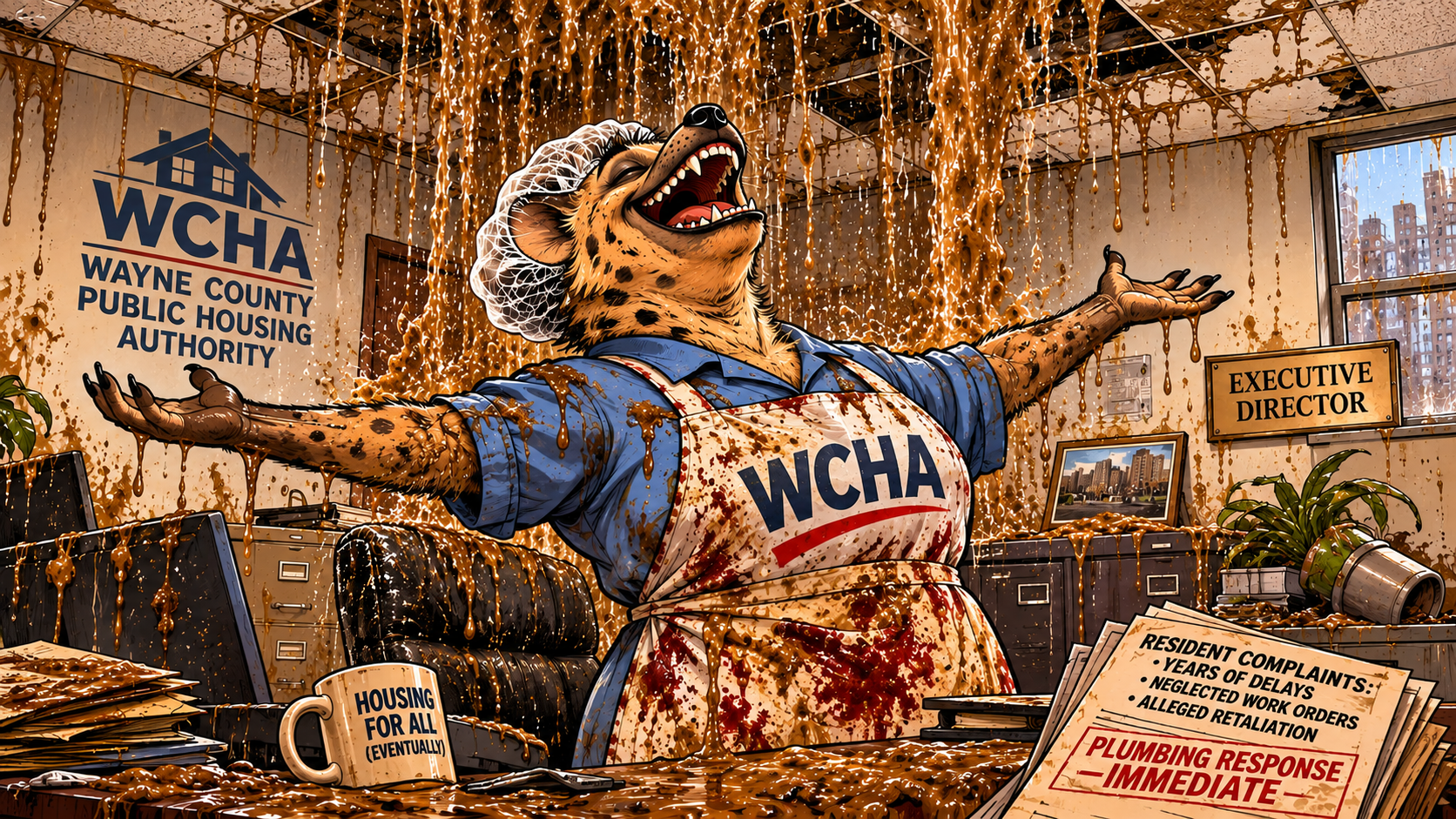
Somewhere on the first floor of the Wayne County Housing Authority, in the office of Executive Director Kim Musgrave, the ceiling has reportedly entered the chat.
According to Monster News reporting today, the WCHA’s first-floor administrative office is dealing with a sewage plumbing failure. The reported problem starts above it: a leak or backup in the plumbing serving the ten floors over the executive director’s head, with sewage reportedly making its way down into the office below.
The call went out to Hayes Plumbing.
And somewhere in a resident’s apartment, a carpet that was reportedly soaked with sewage a week ago is still a carpet that was reportedly soaked with sewage.
THE IRONY IS NOT SUBTLE
This is not really a story about pipes. Pipes fail. Buildings age. In a county where the housing authority is entrusted with the homes of people who have nowhere else to go, what matters is not whether plumbing fails. It is what happens next, to whom, and how fast.
On that measure, residents say they have been asking the same question for a long time, and hearing the same answer: wait.
WHEN IT IS YOUR OFFICE, THE PHONE GETS ANSWERED
Residents have repeatedly described to Monster News maintenance requests that went unanswered or unresolved for unreasonable stretches of time. They have described work orders that sat. They have described conditions serious enough that they called them potentially life-threatening. They have described calling about sewage and sanitation and getting what they characterize as an inadequate response. Some have alleged retaliation after they complained about conditions.
Those are residents’ accounts, reported as accounts. They are not court findings, and Monster News is not presenting them as proven fact.
But one of those accounts is unusually specific, and unusually close to this week’s news: a resident whose apartment took a sewage backup, whose carpet and flooring were reportedly saturated, who received what was described as minimal help with the underlying problem, and who was not relocated. About a week later, that resident was reportedly still saying the carpet was wet and contaminated.
Then sewage reportedly reached the executive director’s office, and a plumber was summoned.
We are not alleging that anyone caused a plumbing failure, that an invoice proves neglect, or that a backed-up drain is retaliation with a wrench. Sewage does not check who signs the lease.
THE ONLY QUESTION THAT MATTERS
Here it is, and it is not complicated.
When sewage is in a resident’s home, how long is that resident supposed to wait for meaningful help?
When sewage is in the executive director’s office, how quickly does the maintenance response change?
If the answer to both questions is the same, the housing authority should have no trouble saying so on the record, with dates and work-order numbers. If the answers are different, Wayne County just learned something about how the authority ranks a flooded apartment against a flooded administrator.
WHAT WE KNOW, AND WHAT WE DO NOT
Documented: the office is on the first floor, the executive director is Kim Musgrave, the affected area is her office, Hayes Plumbing was reportedly contacted, and the reported source is plumbing serving ten floors above.
Reported but not independently confirmed by Monster News at publication: the exact scope of the leak, whether repairs have started or finished, what Hayes Plumbing found, and any statement from the authority or its executive director. None had been provided to Monster News as of this writing. If the authority wants to correct or add to any of it, the record will be updated.
Clearly labeled editorial satire: the laughing hyena, the hairnet, the bloodstained apron, and the phrase “poetic justice.” The health hazards residents describe are not the joke. The joke is an institution that discovers urgency the moment urgency moves into its own office.
THE PART THAT IS NOT FUNNY
There is something profoundly revealing about an institution’s maintenance priorities when the people responsible for overseeing the operation finally find themselves on the receiving end of the very conditions residents have reportedly been describing.
Apparently, sewage has a way of getting management’s attention.
Have a good one, my fellow madmen and madwomen. If your ceiling is dripping something you did not invite, put it in writing, keep the date, and send it to us.
Monster News — Reporting What Others Would Rather Flush.